Commercial loans and commercial lending
A commercial loan is a loan to a business for a business purpose — and, in the other sense of the phrase, a loan secured by commercial property. HomeSec writes both: $20,000 to $5,000,000, secured by commercial property to 70% LVR or residential to 80%, funded in as little as 24 hours, with no valuation and no financials. Commercial lending without the bank's timetable.
See if you qualify in sixty seconds. No credit check to apply, no financials, no payments for the first six months. That's the HomeSec Advantage.
See if you qualifyTwo things people mean by "commercial loan"
The phrase does double duty, and it is worth separating the two before anything else, because the answer to "can HomeSec help" is yes to both but for different reasons.
- A loan to a business
- "Commercial lending" is what a bank calls business lending. The loan is for a business purpose — stock, plant, premises, tax, a contract, a gap — and the borrower is a company, trust or sole trader. In this sense every loan HomeSec writes is a commercial loan, and the security can be any real estate, including the director's home.
- A loan secured by commercial property
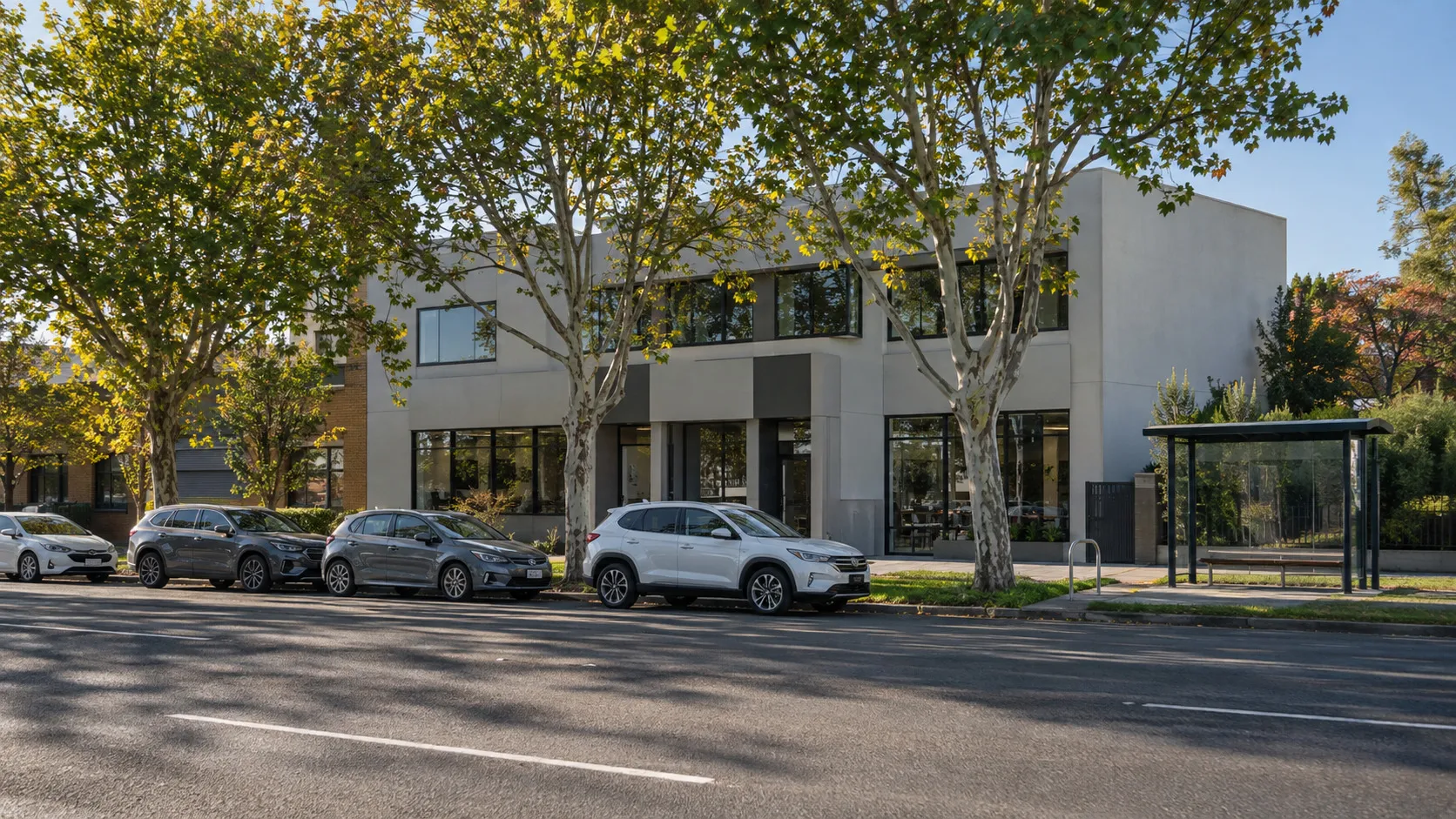
- The shop, the office, the warehouse, the factory. Here the word describes the security, and it changes the file: commercial property is assessed to 70% rather than 80%, and it is where a bank's process is slowest — valuation, lease review, serviceability — and where ours is not.
Commercial lending, commercial finance, commercial business loans, a commercial mortgage: the same money, described from different angles. What matters is not the phrase but two questions — what is the security, and how does the loan get repaid.
Why commercial lending is slow at a bank, and fast here
A bank's commercial loan runs three to eight weeks, and most of that is not the decision. It is the valuation — a registered valuer, a fee, a week or two — and the financials: two years of accounts, interim figures, an ATO portal print-out, a lease schedule, and a serviceability calculation that treats the last two years as the next two.
HomeSec does not order valuations; we assess the security ourselves. We do not ask for financials; we assess the property and the exit. A Lending Manager reads the file and gives you an indicative answer on the first call. From a clean, complete scenario, funding is as little as 24 hours. That is not a promise to cut corners — it is the removal of the two steps that were never about whether you could repay.
Commercial property we lend against
| Security | Accepted | What to know |
|---|---|---|
| Retail — shops, strips, showrooms | Yes | Tenanted or owner-occupied. Vacancy is considered, not disqualifying. |
| Office — suites, small buildings | Yes | Strata offices included. |
| Industrial — factories, warehouses, workshops | Yes | Often the strongest commercial security we see. |
| Mixed-use — shop below, residence above | Yes | Assessed on the commercial component, so the 70% ceiling applies. |
| Rural and agricultural | Yes | Lower LVRs on large acreage; assessed on merit. |
| Vacant land — commercial or residential zoning | Yes | Lower LVR than an improved property. |
| Specialised — pubs, childcare, service stations | On merit | Call. Some are straightforward, some are not, and we will say which on the first call. |
First or second-ranking mortgage. Cross-collateralisation across multiple properties. Your home can be the security. Almost anywhere in Australia — metro, regional and rural; towns of 3,000 or more people as a guide; smaller populations on merit.
How much you can borrow against commercial property
Take the property's value, multiply by 70%, and subtract whatever stays on title ahead of us. What is left is roughly what is available, between $20,000 and $5,000,000. Where a residential property is added as security, its 80% ceiling applies to it — the two are assessed separately and added together.
| Security | Value | Ahead of us | Ceiling | Available |
|---|---|---|---|---|
| Warehouse, owned outright | $1,800,000 | — | 70% — $1,260,000 | $1,260,000 |
| Shop with bank loan paid out | $1,200,000 | $350,000 | 70% — $840,000 | $490,000 |
| Office suite, second mortgage behind bank | $950,000 | $400,000 stays | 70% — $665,000 | $265,000 |
| Factory + director's home, cross-collateralised | $2,400,000 + $900,000 | $600,000 stays | 70% + 80% | $1,800,000 |
Indicative only. Value is our own assessment of the security, not a formal valuation.
Buying commercial property
A purchase is a first mortgage over the property being bought, settled to the vendor's timetable rather than a bank's. Where the contract has a settlement date the bank cannot meet — or where finance was approved and then withdrawn — we can fund the settlement and be refinanced by the bank afterwards, at the bank's pace.
We can fund the purchase of a commercial property, in a personal name or a company name, and the purchase of a residential property in a company name. We cannot fund the purchase of a residential property in a personal name: credit for that purpose is regulated consumer credit under the NCCP Act, and HomeSec lends for business and investment purposes only.
What commercial borrowers use it for
- Buying premises
- The factory you have rented for a decade comes up for sale, and the bank wants eight weeks. First mortgage over the purchase, settled on the vendor's date.
- Fit-out, plant and stock
- Equity in the premises or the home, released against a contract, a season or an order. No repayments while the money does its work.
- The ATO, before it becomes a director's problem
- One loan, paid direct to the ATO, secured by the business's property. The tax debt pages cover the mechanics.
- Bridging a sale of premises
- The building is under contract; the money is needed before settlement. First or second mortgage, repaid from the proceeds.
- Refinancing out of a facility that has been called
- A bank that has withdrawn, re-priced or demanded repayment. We pay it out, and the relationship ends on your terms rather than theirs.
Fast and urgent commercial loans
Speed on a commercial file comes from the same place it comes from on any file: the security and the exit are clear, the title is clean, and the documents come back signed. Where a commercial property has an existing lender, the one thing outside our control is how quickly that lender issues a discharge figure or a consent — a day or two for most Australian banks. What makes a file fast and what to do when the date will not move both apply here unchanged.
From the call to the money
Tell us the deal
Amount, purpose, timing, the property and how the loan gets repaid. A Lending Manager gives you an indicative answer on that call — usually in minutes.
Minutes
Conditional approval
Photo ID, a rates notice and your most recent mortgage statement. That is the whole list, and it takes about fifteen minutes.
About 15 minutes
Funds released
As little as 24 hours from a clean, complete scenario. Paid where you tell us — to your account, or straight to the ATO.
As little as 24 hours
What it costs
Priced per file, on the property, the position, the amount and the exit. We do not publish a rate, because a rate with "from" in front of it is the number the best file gets and tells you nothing about yours. Here is how it is priced, and every fee that exists.
And the limitation, stated plainly: a commercial loan solves a timing problem. If the business is losing money on every job, borrowing against the factory does not fix the job. We decline those files, and we would rather say so in the first ten minutes.
Questions we get on the phone
Is a commercial loan the same as a business loan?
What is the maximum LVR on commercial property?
Can I buy a commercial property with it?
Do you lend against my business premises if I still owe the bank?
How fast is a commercial loan?
Do you need my business's financials?
Can the loan be in my company's name against my personal property?
Is it interest-only?
What does a commercial loan cost?
Do you lend on commercial property in regional areas?
What is the difference between a commercial mortgage and a commercial loan?
Not a call centre. Tell us the property, the amount and the purpose, and we will tell you the position that fits and what it costs. 1300 93 83 87, Mon–Fri, 8:30am – 5:30pm Melbourne time.
Private lending since 2004. Commercial lending is what a bank calls it; these are the shapes it takes.
See if you qualify in sixty seconds
Three short questions, no credit check to apply and no financial statements. A Lending Manager reads it and calls you back with a real answer — not a call centre, not an algorithm.
That's the HomeSec Advantage.
Reviewed by Catriona Anderson, General Manager